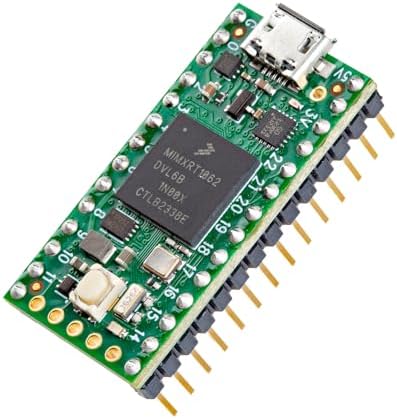

Features am ARM Cortex-M7 processor at 600MHz with a NXP iMXRT1062 chip: a true real-time microcontroller platform
Dual-issue superscaler processor: Can execute two instructions per clock cycle
Tightly Coupled Memory: allows fast single cycle access to memory using a pair of 64 bit wide buses
Provides a power shut-off feature: By connecting a pushbutton to the On/Off pin, the 3.3V power supply can be completely disabled by holding the button for 5 seconds, & turned back on by a brief button press
The same size and shape as Teensy 3.2: Retains compatibility with most of the pin functions. Pre soldered header pins
When running at 600 MHz, it consumes approximately 100mA current. Provides support for dynamic clock scaling. Unlike traditional microcontrollers, where changing the clock speed causes wrong baud rates & other issues, Teensy 4.0 hardware & Teensyduino's software support for compatible with Arduino timing functions are designed to allow dynamically speed changes. Serial baud rates, audio streaming sample rates, & compatible with Arduino functions like delay() & millis(), & Teensyduino's extensions like IntervalTimer & elapsedMillis, continue to work properly while the CPU changes speed. Can also be overclocked, well beyond 600MHz! Executing two simultaneously depends upon the compiler ordering instructions & registers. Initial benchmarks have shown C++ code compiled by compatible with Arduino tends to achieve two instructions about 40% to 50% of the time while performing numerically intensive work using integers & pointers. Cortex-M7 is the first ARM microcontroller to use branch prediction. After a loop has executed a few times, the branch prediction removes that overhead, allowing the branch instruction to run in only a single clock cycle. The ITCM bus provides a 64 bit path to fetch instructions. The DTCM bus is actually a pair of 32 bit paths, allowing M7 to perform up to two separate memory accesses in the same cycle. These extremely high speed buses are separate from M7's main AXI bus, which accesses other memory & peripherals. 512K of memory can be accessed as tightly coupled memory. Teensyduino automatically allocates your compatible with Arduino sketch code into ITCM & all non-malloc memory use to the fast DTCM, unless you add extra keywords to override the optimized default. Memory not accessed on the tightly coupled buses is optimized for DMA access by peripherals. Because the bulk of M7's memory access is done on the two tightly coupled buses, powerful DMA-based peripherals have excellent access to the non-TCM memory for highly efficient I/O.
Amazon.com Return Policy: You may return any new computer purchased from Amazon.com that is "dead on arrival," arrives in damaged condition, or is still in unopened boxes, for a full refund within 30 days of purchase. Amazon.com reserves the right to test "dead on arrival" returns and impose a customer fee equal to 15 percent of the product sales price if the customer misrepresents the condition of the product. Any returned computer that is damaged through customer misuse, is missing parts, or is in unsellable condition due to customer tampering will result in the customer being charged a higher restocking fee based on the condition of the product. Amazon.com will not accept returns of any desktop or notebook computer more than 30 days after you receive the shipment. New, used, and refurbished products purchased from Marketplace vendors are subject to the returns policy of the individual vendor.
Product Warranty: For warranty information about this product, please click here