


Buy New
-
To see product details, add this item to your cart.
Ships from: Amazon Sold by: Echoes and Ink
Save with Used - Acceptable
-
To see product details, add this item to your cart.
Ships from: Seattlegoodwill Sold by: Seattlegoodwill
Sorry, there was a problem.
There was an error retrieving your Wish Lists. Please try again.Sorry, there was a problem.
List unavailable.
Download the free Kindle app and start reading Kindle books instantly on your smartphone, tablet, or computer - no Kindle device required.
Read instantly on your browser with Kindle for Web.
Using your mobile phone camera - scan the code below and download the Kindle app.

Follow the authors
OK
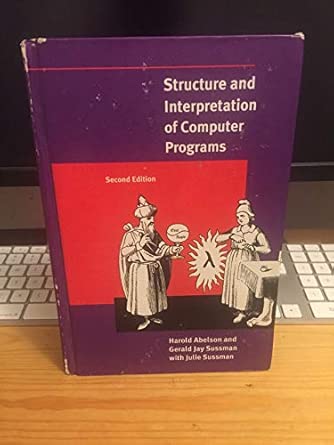
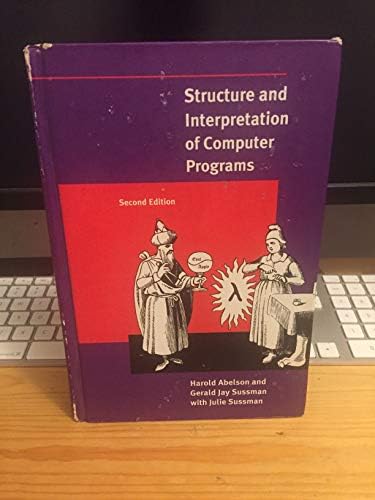
Structure and Interpretation of Computer Programs - 2nd Edition (MIT Electrical Engineering and Computer Science) Subsequent Edition
Purchase options and add-ons
There are new implementations of most of the major programming systems in the book, including the interpreters and compilers, and the authors have incorporated many small changes that reflect their experience teaching the course at MIT since the first edition was published.
A new theme has been introduced that emphasizes the central role played by different approaches to dealing with time in computational models: objects with state, concurrent programming, functional programming and lazy evaluation, and nondeterministic programming. There are new example sections on higher-order procedures in graphics and on applications of stream processing in numerical programming, and many new exercises.
In addition, all the programs have been reworked to run in any Scheme implementation that adheres to the IEEE standard.
- ISBN-100262011530
- ISBN-13978-0262011532
- EditionSubsequent
- PublisherMit Pr
- Publication dateJuly 25, 1996
- LanguageEnglish
- Dimensions6.25 x 1.5 x 9.25 inches
- Print length657 pages
Frequently bought together

Customers who viewed this item also viewed

Code: The Hidden Language of Computer Hardware and SoftwarePaperbackGet it as soon as Wednesday, Jun 3
Operating Systems: Three Easy PiecesPaperbackFREE Shipping on orders over $35 shipped by AmazonGet it as soon as Wednesday, May 27
C Programming Language, 2nd EditionPaperbackFREE Shipping by AmazonGet it as soon as Wednesday, May 27
Customers also bought or read
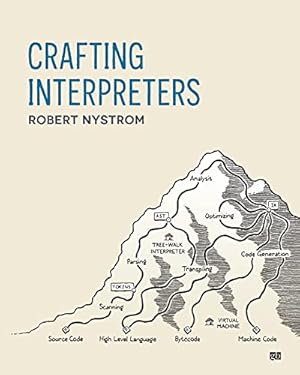
- Crafting Interpreters#1 Best SellerSoftware Programming Compilers
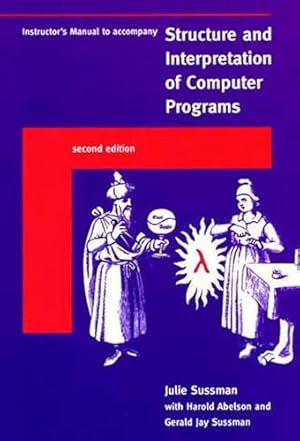
Paperback$43.56$43.56FREE delivery Wed, May 27 - Instructor's Manual t/a Structure and Interpretation of Computer Programs - 2nd Edition
Paperback$40.00$40.00FREE delivery Wed, May 27 - Operating Systems: Three Easy Pieces#1 Best SellerComputer Operating Systems Theory
Paperback$28.27$28.27Delivery Wed, May 27 - The Algorithm Design Manual (Texts in Computer Science)
Hardcover$54.44$54.44FREE delivery Wed, May 27 - How to Design Programs, second edition: An Introduction to Programming and Computing (Mit Press)
Paperback$56.22$56.22FREE delivery Wed, May 27 - Software Design for Flexibility: How to Avoid Programming Yourself into a Corner
Hardcover$55.00$55.00FREE delivery Wed, May 27 - C Programming Language, 2nd Edition#1 Best SellerC Programming Language
Paperback$60.30$60.30FREE delivery Wed, May 27 - Art of Computer Programming, The, Volumes 1-4B, Boxed Set
Hardcover$253.99$253.99FREE delivery Wed, May 27 - Structure and Interpretation of Computer Programs: JavaScript Edition (MIT Electrical Engineering and Computer Science)
Paperback$74.00$74.00FREE delivery Wed, May 27 - Design Patterns: Elements of Reusable Object-Oriented Software#1 Best SellerObject-Oriented Design
Hardcover$26.53$26.53Delivery Jun 6 - 8 - Introduction to Algorithms, fourth edition#1 Best SellerComputer Algorithms
Hardcover$102.99$102.99FREE delivery Wed, May 27 - The Pragmatic Programmer: Your Journey To Mastery, 20th Anniversary Edition (2nd Edition)#1 Best SellerSoftware Design & Engineering
Hardcover$52.99$52.99FREE delivery Wed, May 27 - A Philosophy of Software Design, 2nd Edition#1 Best SellerMicrosoft Programming
Paperback$22.95$22.95Delivery Wed, May 27 - The Elements of Computing Systems, second edition: Building a Modern Computer from First Principles
Paperback$40.61$40.61FREE delivery May 29 - 31 - TCP/IP Illustrated: The Protocols, Volume 1 (Addison-Wesley Professional Computing Series)#1 Best SellerTCP-IP
Hardcover$69.99$69.99FREE delivery Wed, May 27 - Mythical Man-Month, The: Essays on Software Engineering, Anniversary Edition
Paperback$24.07$24.07Delivery May 28 - 29 - Systems Performance (Addison-Wesley Professional Computing Series)#1 Best SellerComputer Performance Optimization
Paperback$64.49$64.49FREE delivery Wed, May 27
Editorial Reviews
Amazon.com Review
The authors employ this philosophy in their writing technique. The text asks the broad question "What is programming?" Having come to the conclusion that programming consists of procedures and data, the authors set off to explore the related questions of "What is data?" and "What is a procedure?"
The authors build up the simple notion of a procedure to dizzying complexity. The discussion culminates in the description of the code behind the programming language Scheme. The authors finish with examples of how to implement some of the book's concepts on a register machine. Through this journey, the reader not only learns how to program, but also how to think about programming.
About the Author
Product details
- Publisher : Mit Pr
- Publication date : July 25, 1996
- Edition : Subsequent
- Language : English
- Print length : 657 pages
- ISBN-10 : 0262011530
- ISBN-13 : 978-0262011532
- Item Weight : 2.25 pounds
- Dimensions : 6.25 x 1.5 x 9.25 inches
- Part of series : MIT Electrical Engineering and Computer Science
- Best Sellers Rank: #1,131,032 in Books (See Top 100 in Books)
- #4 in Lisp Programming
- #945 in Computer Programming Languages
- #8,865 in Mathematics (Books)
- Customer Reviews:
About the authors

Gerald Jay Sussman (February 8, 1947) is the Panasonic Professor of Electrical Engineering at the Massachusetts Institute of Technology (MIT). He received his S.B. and Ph.D. degrees in mathematics from MIT in 1968 and 1973 respectively. He has been involved in artificial intelligence research at MIT since 1964. His research has centered on understanding the problem-solving strategies used by scientists and engineers, with the goals of automating parts of the process and formalizing it to provide more effective methods of science and engineering education. Sussman has also worked in computer languages, in computer architecture and in VLSI design.
Bio from Wikipedia, the free encyclopedia. Photo by Massachusetts Institute of Technology, Department of Electrical Engineering and Computer Science [CC BY-SA 1.0 (http://creativecommons.org/licenses/by-sa/1.0)], via Wikimedia Commons.

Discover more of the author’s books, see similar authors, read book recommendations and more.

Hal Abelson is Class of 1922 Professor of Computer Science and Engineering at Massachusetts Institute of Technology and a fellow of the IEEE. He is a founding director of Creative Commons, Public Knowledge, and the " "Free Software Foundation. Additionally, he serves as co-chair for the MIT Council on Educational Technology.
Customer reviews
Customer Reviews, including Product Star Ratings help customers to learn more about the product and decide whether it is the right product for them.
To calculate the overall star rating and percentage breakdown by star, we don’t use a simple average. Instead, our system considers things like how recent a review is and if the reviewer bought the item on Amazon. It also analyzed reviews to verify trustworthiness.
Learn more how customers reviews work on AmazonCustomers say
Generated from the text of customer reviewsSelect to learn more
Reviews with images
ordered as new but came in with far too much damage to be considered new or even close to it.
Top reviews from the United States
- 5 out of 5 stars
The Art of Generalization.. TOUGH but possibly worth it
Reviewed in the United States on July 11, 2013Inductive reasoning aims at simplifying functions just enough to make them general. Simple does NOT equal easy! When Functional Programming (and its predecessors-- combinatory logic (1925) and lambda calculus (1930)) were first invented, they were aimed at clarifying mathematical logic. This "holding variables constant" or binding or eliminating them for "pure" (mathematical) functions, has been extended to Functional Programming, initially to better understand what programming is in general, then to evaluate mathematical functions while avoiding some of the complicating factors (side effects) of imperative/procedural programming.
Because of this, when you think of a function in imperative, you immediately think of variables, and such functions can very easily morph both at the algo/function f(x)-> g(x) level, and at the x (variable level) itself (data changing as you execute). In functional programming (the subject of this text), a function is, well, a MATH function! So, evolving from math, and consisting OF math, it would be a little surprising to criticize the fact that this IS A MATH BOOK. (Sorry, it is). On the other hand, holding those variables constant and looking directly at functional mappings (particularly recursion) can "AHA" us into seeing how computers and programming "really" work without the complications of heavy imperative morphs.
After C# 3 and in some Perl, these tried and true oops also have some functional classes now, so we are moving toward a more hybrid world, making this book FAR from out of date, even though it is "temporally" older. As well, some of your favorite math, research and engineering programs (Maple, Mathematica and R, for example) have numerous functional features. The old FP standbys are, of course, Lisp, Scheme, Hope, Haskell, Clojure, Racket, Hope, Scala, F#, etc. which you probably think of more as "math" programs. But, hopefully not a surprise, SQL itself strives at far less mutable value structures than imperative, and thus tilts toward functional also.
FP, to be very honest, WAS designed to teach and understand programming (at compile/interpret levels, not necessarily algorithms, computational complexity or even advanced data structures), not originally create useful programs! "R" and many others have proved that to be aiming low, and the newer FP books do of course get deeply into more recent data structures.
Thus, the reason for so many negative reviews! This is NOT your usual "how to program" or even "what are programs" text-- it really is about linking mathematics and computer science at both high and deep levels. So, if you aren't really up on math (from basics like sets and real number mappings all the way up to Lie Algebras and tensors), you might get lost with this rare gem of a book. On the other hand, the pain of working through it will give you a perspective on computer science that will forever change your point of view. Even if you code all day like I do, you'll LOVE taking this journey both to the 30,000 foot level, as well as down to the real action between compiling and interpreting-- via the MATHEMATICS of "pure" functions, minus the confusion of changing states, variables and data we play with every day in the imperative version of functions. Don't believe that this "simplification" makes things easier to get-- unless you know functions from a deep math view, this will be a tough climb.
But... worth it if you're willing to do the work! Most other books on "discrete math" are really UI catch ups for all the computer/math that's now been removed from High School curricula, making this one of the few "real deals" that are at a bright, high undergrad level, NOT catch up. By removing calculus from HS requirements, we're teaching 2,500 year old math, and adding the basics brings us up to 1666 or so. This book rapidly catapults our function math vs. function computing into the new century! Highly recommended IF you're not turned off by advanced math functions, mappings, properties, etc. The next time someone asks how a special or CAS function can run faster interpreted than compiled, you'll have a MUCH different answer! And of course the heart of all dynamical systems today includes differential equations, which are essentially recursive function processing.
BEFORE AND AFTER: If you're not "quite" ready for this level of FP and Lisp, you can get a great, inexpensive backgrounder with Dover's An Introduction to Functional Programming Through Lambda Calculus (Dover Books on Mathematics). Mathwise, many Dover books on the keyword recursive functions will help. For a freebie intro, Graham's famous "on lisp" is now available as a free download, and is a bit above the level of this book. For the "greatest intellectual programming book ever written" (far beyond the level of this book, covering advanced Lisp macros, closures, etc.), check out (AFTER reading this): Let Over Lambda. Only 1% of programmers really understand Common Lisp, and only 1% of those would tackle the unhygenic macros in Let Over-- yet it is so intellectualy challenging that coders and engineers at all levels are astonished when they read it. Shows how high the bar can really get! (Lisp tends to do that, right?).
IS IT DATED? In answer to a bunch of emailers asking that, NO-- the principles of functional are still the same, even if Common Lisp and Scheme have been updated. In fact, today, combinations of functional, imperative and logical are happening more and more (called mixed paradigm programming). However, if you want a GREAT, VERY RECENT book as both a warm up and an update to Abelson, try this little beauty by the same author as the Little Schemer: Realm of Racket: Learn to Program, One Game at a Time!. It will fill in where Abelson is a little out of date AND prepare you for his depth. WARNING: PLEASE BE SURE to get the 2nd Edition of Abelson, he updated it significantly for the relationship between time and memory, a relationship that is even today undergoing a LOT of research in many fields.
61 people found this helpfulSending feedback...Sending feedback...HelpfulThank you for your feedback.Sorry, we failed to record your vote. Please try againThanks, we'll investigate in the next few days.Sorry, We failed to report this review. Please try again - 5 out of 5 stars
Computer Science...Art?
Reviewed in the United States on January 27, 2009You need it, too. I won't pretend to have more useful insight into the art and craft of programming, or into SICP's relationship to it, than Paul Graham or Peter Norvig- if you want to know which reviews to trust, look these cats up.
The discussion in the reviews usually concludes that this is the book that separates the computer scientists from the mere programmers. There is a definite logic to this. If you want a book that will have you churning out code that does something helpful in half an hour(because you don't think the several ways to calculate the Fibonacci Sequence are helpful), by all means, pick up Learning Perl or just read the Python documentation. They are great tools. If, however, you want to tool up on problem-solving technique a whole level or three higher up, SICP is for you. The Wizard Book is about learning to think better.
Here is where I diverge from the idea that this book is for only computer scientists, though. I am an artist, graduated from college with a BA in art, going to graduate school for an MFA. SICP is one of the books that changed how I work and think. It will make you a better programmer if you read (and reread (and reread)) it in the same way that learning Latin will make you understand language itself in a whole new way. I use ideas from SICP constantly, to design software, but also to design staircases. The book is slow-going, no doubt about it, but you'll have a whole new mental toolset at the end.
One caveat- this book is freely distributed in its entirety on MIT's website. I still bought a copy, though: who knows how long this internet thing will last, but SICP is going to be relevant forever.
95 people found this helpfulSending feedback...Sending feedback...HelpfulThank you for your feedback.Sorry, we failed to record your vote. Please try againThanks, we'll investigate in the next few days.Sorry, We failed to report this review. Please try again - 5 out of 5 stars
Saves the environment. Cures cancer. Improves health. Saves lives.
Reviewed in the United States on August 11, 2013Reading this book will save the environment.
You'll learn how to write efficient software that doesn't require the output of 3 coal burning power plants operating at 100% just to run.
Reading this book can cure cancer.
Want to know the real reason we haven't cured cancer? It's because too many companies need the yearly GDP of a third world nation for hardware purchases to run software,or to fix software written by men and women who didn't read this book. Reading this book will make the software you write more logical, less expensive to fix, less expensive to maintain, and less expensive to operate. Don't create new problems that prevents us from curing cancer, read this book.
Reading this book cures alcoholism and improves health. Reading this book saves lives.
Poorly written software is one of the leading causes of hypertension and other stress related health problems, including deaths attributed to heart attacks. At the very least, reading this book may save several people from crawling into a bottle to escape the mental abuse of understanding what your code is doing.
Remember friends don't let friends write software if they haven't read this book. The life and sanity you save may very well be your own.
36 people found this helpfulSending feedback...Sending feedback...HelpfulThank you for your feedback.Sorry, we failed to record your vote. Please try againThanks, we'll investigate in the next few days.Sorry, We failed to report this review. Please try again - 5 out of 5 stars
The best programming book ever, if you're a certain kind of person
Reviewed in the United States on August 26, 2014This was the book that made me want to be a computer programmer. When I read it, I had no knowledge of programming beyond a little Pascal, and rudiments of C.
It had a massive impact on me. It consumed me, to the point where I had difficulty finishing assignments for my classes (I did not study CS as an undergrad). What the book does is give you a vocabulary and knowledge about programming that is hard to find anywhere else.
The text, the examples and exercises, have a mathematical flavor, and that may turn off many potential readers, who would rather gadget around than find elegant solutions for the 8-queens puzzle or efficient algorithms to compute Fibonacci numbers.
I've lent this book to several friends who were interested in learning to program, and in all cases they have returned it to me, saying it went over their heads.
There seem to be two camps in computer programming:
- the gadgeteers, who want to hook devices together and make them do fun things
- the scientists, who appreciate computing as a medium in itself
This book is for the second type.
240 people found this helpfulSending feedback...Sending feedback...HelpfulThank you for your feedback.Sorry, we failed to record your vote. Please try againThanks, we'll investigate in the next few days.Sorry, We failed to report this review. Please try again - 5 out of 5 stars
The definitive book on functional programming
Reviewed in the United States on March 22, 2013I bought this book at the recommendation of a speaker on Functional Programming at a Computing Conference. It was on his list of the 10 most important books in Computer Programming. I am doing the "paradigm" shift to Functional Programming and Learning Clojure, so I thought it would be a good book to have on my Shelf. And the Paperback version was less expensive than the hardback.
It arrived very quickly in excellent shape.
I've been developing software since the 70's and have undergone the shifts in COBOL to Yourdon's Structured Design, to C then C++, OOP in Java and C++ and now to Clojure and Scala. I'm using this book as a supplement to learning Clojure, although the code is in Lisp. The material is very dense and thorough. The beauty of this book, however, is it leads you into Functional Programming without one even knowing it. I am only part way through it (converting the examples from Lisp to Clojure as I go) and my understanding of FP has grown by leaps and bounds.
11 people found this helpfulSending feedback...Sending feedback...HelpfulThank you for your feedback.Sorry, we failed to record your vote. Please try againThanks, we'll investigate in the next few days.Sorry, We failed to report this review. Please try again - 4 out of 5 stars
Awesome text, but not for beginners
Reviewed in the United States on June 29, 2010Having first watched the authors' excellent video lectures that were built upon the first edition of this textbook I naturally had very high expectations when I set my hands on the second edition. The breadth of the material covered by this book is very much in line with its title. The central topic of the book, as one would expect, are computer programs. And it is here that the book really shines, progressively refining the readers' idea of what a computer program essentially is through multiple interpretations and re-interpretations of that idea.
That being said, this book does take the unconventional approach: it uses a relatively unknown language called Scheme and goes into considerable effort to promote functional programming, an approach still considered pariah in the industry. But this is no flaw in my opinion. Current trends in programming language evolution indicate that many ideas that were hitherto the sole province of functional programming will become more and more present in mainstream languages.
The beauty of Scheme is that it hardly has any syntax and its few special forms can all be learned in a very short time, liberating the reader from the so ubiquitous tyranny of syntax that plagues the majority of programming textbooks out there. The Scheme that the authors present in this book has no looping constructs: believe you me, there really is something special in writing loops via function recursion - it reminded me of my high-school days and the infamous goto's I would regularly get chided for by the teacher. Interestingly, in the fourth chapter of the book you get to implement some of these absent looping constructs yourself.
Another nice thing about the book is that it constantly keeps challenging you: the exercises get progressively more difficult and there are very few one could skip on the basis of them being trivial or non-engaging.
I was surprised though, to have seen that many colleges did, or still do, use this textbook as a basis for a first course in computer programming. I find this inappropriate because there is far too little in the way of teaching the essential algorithms and program design patterns for beginners to really profit from here. In my opinion, the material in this book is more suited for computer science sophomores instead.
One of my biggest gripes with this text had to do with the way the exercises were laid out: on far too many occasions, the book doesn't present you with enough of workable code to test and verify your solutions - while an experienced programmer will have easily dealt with this issue by consulting MIT's 6.001 course webpage and downloading the code set for the book, a soloing beginner could possibly be frustrated to the point of giving up on the book. The stream section in chapter 3 is especially troublesome since there is no officially provided workable code at all either in or outside the text - again, the solution is pretty simple, but to a beginner probably insurmountable without assistance. I strongly suggest using the DrScheme environment and switching to Lazy Scheme for the purposes of this section. In fact, one can use DrScheme for most of the book, as it's far more user friendly than MIT Scheme Emacs and diverges from MIT GNU dialect of Scheme in only a few sections of the book. One annoying feature of DrScheme is that it has recently rendered set-car! and set-cdr! procedures obsolete: fortunately, the solution is simple. Just add "(require r5rs)" at the top of the definition window.
A second potential problem for students that I see, is a thorough lack of commentary on domains and codomains of functions in the programs. Since Scheme is a dynamically typed language, there is no self-documentation present as there would be were the programs written in a typical statically typed language such as C++, and for a streamlined reading experience such documentation is a must.
With all of this in mind, and considering this textbook as an intermediate rather than beginner level material, I rate it as very good, with potential for excellence should the problems I mentioned be resolved.
If you decide to read the book, I warmly recommend that you watch the eponymous video lectures in parallel as they are thoroughly entertaining and on some occasions go into interesting theoretical discussions not to be found in the book (you definitely don't want to miss the lecture on the metacircular evaluator as it's far more clear than the presentation in the book and concludes with some really nice lambda calculus hacks).
28 people found this helpfulSending feedback...Sending feedback...HelpfulThank you for your feedback.Sorry, we failed to record your vote. Please try againThanks, we'll investigate in the next few days.Sorry, We failed to report this review. Please try again - 5 out of 5 stars
A Computer Science grand tour
Reviewed in the United States on March 16, 2007This text introduces CS essentials in an engaging and practical way. The first two chapters on procedural and data abstraction are much better CS preparation than learning Java or C++ or Ada or Pascal. Abstraction and specification in software development are absolutely necessary if software "art" is ever to become a "science."
I used this text last year to teach a one year introduction to computer science to some rather advanced homeschooled high school students. Scheme is a much better choice for a teaching language than C++ or Java. There is no need to deal with memory management issues as with C++ and the development model is simpler than with Java. And scheme makes many things easier to achieve than with other languages: higher-order procedures (chapter 1) and hierarchical data (chapter 2).
For my own enjoyment and personal enrichment I have used chapters 4 and 5 as a basis for my own explicit control evaluator for scheme in C++.
A classic. Every CS graduate should do remedial work now and read this text, if they have not done so already.
24 people found this helpfulSending feedback...Sending feedback...HelpfulThank you for your feedback.Sorry, we failed to record your vote. Please try againThanks, we'll investigate in the next few days.Sorry, We failed to report this review. Please try again - 5 out of 5 stars
Excellent book!
Reviewed in the United States on August 20, 2018I have only worked part of the way through the book, but it is one of the best books I've had the pleasure of learning from. It has an academic mathematical flavor to it, and the material is fairly dense; but the authors are masterful teachers and the exercises are very effective. Scheme is a fascinating language. At first it is uncomfortable to look at, especially if you're used to more mainstream languages. But once you get acclimated, you begin to see the beauty and raw power it holds. I recommend using the Racket IDE with the SICP extension when working through the book.
36 people found this helpfulSending feedback...Sending feedback...HelpfulThank you for your feedback.Sorry, we failed to record your vote. Please try againThanks, we'll investigate in the next few days.Sorry, We failed to report this review. Please try again
Top reviews from other countries
Thomas Humphreys5 out of 5 starsChanged the entire way I went about programming
Reviewed in the United Kingdom on April 24, 2026Absolutely amazing book, I have been slowly working through it and I can see the way my thinking has been changed by the book and improved. I’m able to solve problems way better than before and for one of the first times ever due to the thinking process taught from the book I had a section of complex code work first try. It has and continues to teach me so much!
Sending feedback...Thanks, we'll investigate in the next few days.Sorry, We failed to report this review. Please try again
Ravi Pun4 out of 5 starsPretty good condition
Reviewed in Australia on August 30, 2024The book is in good condition and i havent have much problems with it for now
4 out of 5 starsPretty good condition
Reviewed in Australia on August 30, 2024The book is in good condition and i havent have much problems with it for now
Sending feedback...Thanks, we'll investigate in the next few days.Sorry, We failed to report this review. Please try again
Cliente Amazon5 out of 5 starsEverlasting programming concepts
Reviewed in Italy on October 16, 2025Wonderful. Teaches a lot of concepts in programming languages theory that will never become obsolete.
Sending feedback...Thanks, we'll investigate in the next few days.Sorry, We failed to report this review. Please try again
Amazon Customer5 out of 5 starsgood stuff
Reviewed in Canada on July 11, 20195/5 would read again
Sending feedback...Thanks, we'll investigate in the next few days.Sorry, We failed to report this review. Please try again
Jorge5 out of 5 starsEntendimiento general de bases de programación
Reviewed in Mexico on October 18, 2021De momento voy en el 2do. capitulo del libro. Tiene bastantes ejercicios por hacer que creo aumentan enormemente la comprensión de lo que el autor habla, por lo que es un punto bueno a comentar, ya que eso es material para bastante tiempo. En general me gusta cómo presenta los conceptos el autor, porque si bien algunas cosas suelen ser "conocidas" como los "procedures", el autor lo presenta de manera que te hace comprender por qué están ahí y por qué tienen valor en un lenguaje de programación.
Sending feedback...Thanks, we'll investigate in the next few days.Sorry, We failed to report this review. Please try again


![Computer Networking Bible: [3 in 1] The Complete Crash Course to Effectively Design, Implement and Manage Networks. Including Sections on Security, Performance and Scalability](https://m.media-amazon.com/images/I/41H4YJnxKgL._AC_SR100,100_QL65_.jpg)