
Sponsored
Enjoy fast, free delivery, exclusive deals, and award-winning movies & TV shows.
Buy New
-58% $27.89
FREE delivery Sunday, June 21 on orders shipped by Amazon over $35
Ships from: Amazon.com
Sold by: Amazon.com
$27.89 with 58 percent savings
List Price: $65.99
Get Fast, Free Shipping with Amazon Prime
FREE delivery Sunday, June 21 on orders shipped by Amazon over $35
Or Prime members get FREE delivery Tomorrow, June 17. Join Prime
Arrives 4 days before Father's Day
In Stock
$$27.89 () Includes selected options. Includes initial monthly payment and selected options. Details
Price
Subtotal
$$27.89
Subtotal
Initial payment breakdown
Shipping cost, delivery date, and order total (including tax) shown at checkout.
Shipper / Seller
Amazon.com
Amazon.com
Shipper / Seller
Amazon.com
Returns
FREE 30-day refund/replacement
Quick refund
Usually issued within 24 hours. See exceptions
FREE return
At least one free return option available.
Convenient dropoff
At any of our 50,000 US locations.
See return policy
Gift options
Available at checkout
Available at checkout This item is a gift. Change
At checkout, you can add a custom message, a gift receipt for easy returns and have the item gift-wrapped
Payment
Secure transaction
Your transaction is secure
We work hard to protect your security and privacy. Our payment security system encrypts your information during transmission. We don’t share your credit card details with third-party sellers, and we don’t sell your information to others. Learn more
$3.45
$3.99 delivery June 24 - 29. Details
Or fastest delivery June 22 - 24. Details
Arrives after Father's Day. Need a gift sooner? Send an Amazon Gift Card today by email or text message.
Only 2 left in stock - order soon.
$$27.89 () Includes selected options. Includes initial monthly payment and selected options. Details
Price
Subtotal
$$27.89
Subtotal
Initial payment breakdown
Shipping cost, delivery date, and order total (including tax) shown at checkout.
Access codes and supplements are not guaranteed with used items.
Ships from and sold by Seattlegoodwill.
Added to

Sorry, there was a problem.

There was an error retrieving your Wish Lists. Please try again.

Sorry, there was a problem.

List unavailable.
Kindle app logo image

Download the free Kindle app and start reading Kindle books instantly on your smartphone, tablet, or computer - no Kindle device required.

Read instantly on your browser with Kindle for Web.

Using your mobile phone camera - scan the code below and download the Kindle app.

QR code to download the Kindle App

  • Design Patterns: Elements of Reusable Object-Oriented Software

Follow the authors

Get new release updates & improved recommendations
See all
Something went wrong. Please try your request again later.

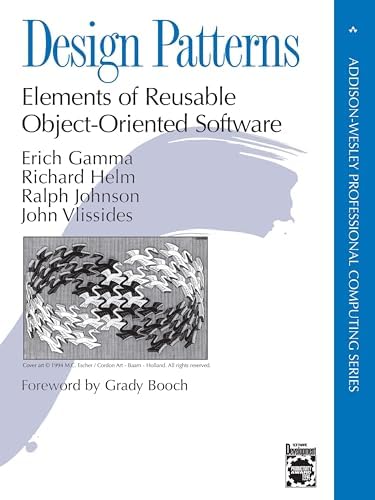
Design Patterns: Elements of Reusable Object-Oriented Software

4.7 out of 5 stars (2,824)

{"desktop_buybox_group_1":[{"displayPrice":"$27.89","priceAmount":27.89,"currencySymbol":"$","integerValue":"27","decimalSeparator":".","fractionalValue":"89","symbolPosition":"left","hasSpace":false,"showFractionalPartIfEmpty":true,"offerListingId":"lmLQw1Bnmsj95w8%2FabRG5NBDrKm9iRyQCgXrMc8DylymfuAIzy76pMBcyBhFQ4recrksTo%2F4dcH5o6F1dRWeVfFrrSBjy6ngdKkLH1dFIpYBo1CVaUMxWN78sAn2aFgFKk86NM0w%2BHE%3D","locale":"en-US","buyingOptionType":"NEW","aapiBuyingOptionIndex":0}, {"displayPrice":"$3.45","priceAmount":3.45,"currencySymbol":"$","integerValue":"3","decimalSeparator":".","fractionalValue":"45","symbolPosition":"left","hasSpace":false,"showFractionalPartIfEmpty":true,"offerListingId":"lmLQw1Bnmsj95w8%2FabRG5NBDrKm9iRyQNPDploEGEPwtwz7UA6L252EZiAbwOWiBQk1UUab%2FkEsdhqypgIIdc9HkTV2BlItjzKzhToimunfZKROl5mi%2BwMsQ4iHoUYHmzl80iH3Q0uPu8fYcZKfQdEpfznLAPh8Nq5u8kZkPz3fEcjxWZDHYOW%2FDqOIQI5RR","locale":"en-US","buyingOptionType":"USED","aapiBuyingOptionIndex":1}]}

Purchase options and add-ons

Capturing a wealth of experience about the design of object-oriented software, four top-notch designers present a catalog of simple and succinct solutions to commonly occurring design problems. Previously undocumented, these 23 patterns allow designers to create more flexible, elegant, and ultimately reusable designs without having to rediscover the design solutions themselves.


The authors begin by describing what patterns are and how they can help you design object-oriented software. They then go on to systematically name, explain, evaluate, and catalog recurring designs in object-oriented systems. With Design Patterns as your guide, you will learn how these important patterns fit into the software development process, and how you can leverage them to solve your own design problems most efficiently.


Each pattern describes the circumstances in which it is applicable, when it can be applied in view of other design constraints, and the consequences and trade-offs of using the pattern within a larger design. All patterns are compiled from real systems and are based on real-world examples. Each pattern also includes code that demonstrates how it may be implemented in object-oriented programming languages like C++ or Smalltalk.

Sponsored

Frequently bought together

This item: Design Patterns: Elements of Reusable Object-Oriented Software
$27.89
Get it as soon as Sunday, Jun 21
In Stock
Ships from and sold by Amazon.com.
+
$45.97
Get it as soon as Sunday, Jun 21
In Stock
Ships from and sold by Amazon.com.
+
$49.09
Get it as soon as Sunday, Jun 21
In Stock
Ships from and sold by Amazon.com.
Total price: $00
To see our price, add these items to your cart.
Details
Added to Cart
Choose items to buy together.

Customers also bought or read

Loading...

From the Publisher

Design Patterns Book and Computer

Must-Read for Every Software Developer and Engineer

This classic is on just about every single must-read list for software developers, engineers, and architects (including lists featured on ZDNET, DZone, Guru99, Built In, Geeks for Geeks, Hacker News, and more) as a bible for solving software design problems effeciently.

Despite being one of the oldest books on a software engineer's shelf, it is still relevant and THE guide to creating reusable designs that are elegant and flexible, without having to rediscover the design solutions themselves.

Editorial Reviews

Amazon.com Review

Design Patterns is a modern classic in the literature of object-oriented development, offering timeless and elegant solutions to common problems in software design. It describes patterns for managing object creation, composing objects into larger structures, and coordinating control flow between objects. The book provides numerous examples where using composition rather than inheritance can improve the reusability and flexibility of code. Note, though, that it's not a tutorial but a catalog that you can use to find an object-oriented design pattern that's appropriate for the needs of your particular application--a selection for virtuoso programmers who appreciate (or require) consistent, well-engineered object-oriented designs.

Review

This book isn't an introduction to object-oriented technology or design. Many books already do a good job of that...this isn't an advanced treatise either. It's a book of design patterns that describe simple and elegant solutions to specific problems in object-oriented software design....Once you understand the design patterns and have had an "Aha!" (and not just a "Huh?" experience with them, you won't ever think about object-oriented design in the same way. You'll have insights that can make your own designs more flexible, modular, reusable, and understandable--which is why you're interested in object-oriented technology in the first place, right? -- From the Preface

This is one of the best written and wonderfully insightful books that I have read in a great long while...this book establishes the legitimacy of patterns in the best way: not by argument, but by example. --
C++ Report

Product details

  • Publisher ‏ : ‎ Addison-Wesley Professional
  • Publication date ‏ : ‎ October 31, 1994
  • Edition ‏ : ‎ 1st
  • Language ‏ : ‎ English
  • Print length ‏ : ‎ 416 pages
  • ISBN-10 ‏ : ‎ 0201633612
  • ISBN-13 ‏ : ‎ 978-0201633610
  • Item Weight ‏ : ‎ 7.4 ounces
  • Dimensions ‏ : ‎ 9.31 x 7.62 x 1.04 inches
  • Best Sellers Rank: #29,601 in Books (See Top 100 in Books)
  • Customer Reviews:
    4.7 out of 5 stars (2,824)

About the authors

Follow authors to get new release updates, plus improved recommendations.
Sponsored

Customer reviews

4.7 out of 5 stars
2,824 global ratings
Sponsored

Customers say

Customers consider this book essential reading for professional programmers, describing it as a definitive guide to design patterns that includes examples for each pattern. Moreover, the content receives praise as a must-have for software design and computer programming architecture, with detailed explanations of concepts. However, customers disagree on the book's clarity and readability, with some finding it easy to understand while others find the concepts hard to grasp and the Kindle edition's diagrams unreadable.
AI Generated from the text of customer reviews

Select to learn more

120 customers mention informative, 113 positive, 7 negative
Customers find the book highly informative, describing it as a seminal reference book on Object-Oriented Programming that is essential reading for professional programmers and particularly useful for advanced OOP developers.
Has been a great resource. Even though I program in ABAP, it helps me to translate the pattern into that code.Read more
I love this book. It's a great book for software developers who want to understand design patterns better.Read more
A fundamental book that examines some of the most basic and important design patterns in Object Oriented Programming....Read more
This is a must-have for any developer....Read more
101 customers mention design patterns, 92 positive, 9 negative
Customers find this book to be a definitive guide to design patterns, with every pattern including examples, making it useful for learning how to apply them.
It presents a collection of design patterns in a good structure: the pattern's motivation, it's description, problems, implementation, known uses....Read more
This is the best book about design pattern. I first read the book 10 years ago....Read more
"Design Patterns: Elements of Reusable Object-Oriented Software" the classicRead more
This is the best book on design patterns, since it has been written by the famous GoF and each one of them is an expert....Read more
97 customers mention content, 88 positive, 9 negative
Customers praise the book's content, describing it as a must-read that serves as an excellent reference and standard in the field.
...Maybe I just haven't come across a situation that requires those. GREAT book, easy to read for the intermediate to pro OOP developer....Read more
...It will remain a great reference book on my shelf in years to come.Read more
Good book, great qualiy !!!Read more
A must read.Read more
24 customers mention detailed, 18 positive, 6 negative
Customers find the book detailed and well-explained, with useful descriptions and helpful diagrams.
...This is for those friends of my who love Java. Its explanations are excellent but for Java guys like me get trouble to understand the sample codes.Read more
This book gives a nice overview of what high-level abstractions to think about, mostly when writing new software....Read more
...Also, as other reviewers have pointed out, the text is too generic and abstract, unless you're into that. Donald Knuth anybody?...Read more
...I use it every time I'm preparing for an interview. Concepts are well explained and it also provides detailed implementations.Read more
22 customers mention software content, 21 positive, 1 negative
Customers praise the book's software content, describing it as a must-have for software design and a foundation of computer programming architecture.
...Otherwise, this book is a must have for software developers!Read more
Great reference for computer programming architecture. Like the Kernigan book for C, this is the antitypical reference for design patterns.Read more
...Clear, sophisticated and yet so important....Read more
...great together to introduce a reader to the world of good software engineering practices....Read more
18 customers mention classic, 18 positive, 0 negative
Customers describe the book as a true classic and timeless, with one customer noting it comes in a deluxe edition.
A classic. Every software engineer should have this in their library....Read more
A classic that's certainly worth having, I've had it for about a year and I've certainly picked it up a few times just to reference certain things....Read more
This book is a classic....Read more
bought this to keep on my bookshelf. its a timeless book which is always referenced....Read more
23 customers mention clarity, 13 positive, 10 negative
Customers have mixed opinions about the clarity of the book, with some finding it easy to understand and concise, while others report that the concepts are hard to understand and the diagrams are not intuitive.
Concise. Readable. Authoritative.Read more
...I found one particular pattern, namely Interpreter, pretty difficult to follow....Read more
Conceptually, this book is ground-breaking and makes perfect sense. There are however a few ways to do some of the things the book lays out....Read more
The concepts are hard to understand. The sample code written in Smalltalk doesn't help much....Read more
19 customers mention readability, 11 positive, 8 negative
Customers have mixed opinions about the book's readability, with some finding it an easy and great read for programmers, while others report that the Kindle edition diagrams are unreadable.
...the book and it's proving an excellent review of OOP as well as a clear instruction on the use of Design Patterns....Read more
Kindle Edition Diagrams UnreadableRead more
Full disclosure have only read 5 pages so far but a dense read and full of useful information. Can't wait to read it cover to coverRead more
Tough reading if weren't a C++ or Smaltak programmer, which is my case, because all sample code are written in those languages....Read more
1 month delayed in delivery, but still got it
5 out of 5 stars
1 month delayed in delivery, but still got it
The book is almost brand new. Hardcover, pages were clean, no folds.
Thank you for your feedback
Sorry, there was an error
Sorry we couldn't load the review

Top reviews from the United States

  • 5 out of 5 stars
    Talk the talk while you walk the walk (learn universal standardized vocabulary for design patterns)
    Reviewed in the United States on June 9, 2026
    Brief content visible, double tap to read full content.
    Full content visible, double tap to read brief content.

    Before I give this text my seal of approval (and you choose to do your own research) I will point out that this text was written in 1994. That said, every serious software designer should know the design patterns highlighted in this book. All of the patterns are categorized as either creational, structural, or behavioral. And as stated in the title, these patterns fit within the object-oriented paradigm making them useful in contexts beyond C++. Furthermore, the reader benefits from having a universal standardized vocabulary for describing how he designs his programs. The names given to the design patterns are intuitive making it easy memorization material; easy to absorb the substance of this professional topic. If you have even the slightest interest in discussion of your programming practices with your peers, do not hesitate to buy Design Patterns by the "Gang of Four" (referring to the authors).

    Sending feedback...
    Thank you for your feedback.
    Sending feedback...
    Thanks, we'll investigate in the next few days.
  • 5 out of 5 stars
    An absolute masterpiece even in 2022 - Evergreen Principles of Software Architecture
    Reviewed in the United States on September 2, 2022
    Brief content visible, double tap to read full content.
    Full content visible, double tap to read brief content.

    This book characterizes the kind of thinking that moves you from the low-level 'small' view of a software developer to the high level long-term view of a software architect.

    While entry-level and junior developers may spent hours arguing fruitlessly over whether OOP is dead or alive, or whether functional programming is better or worse, most senior engineers and software architects are able to use many different paradigms. They understand that these patterns are deeper than the paradigm they are implemented in.

    They understand that the concepts and ideas underlying these design patterns cannot and will not ever die because they express evergreen solutions to dealing with evolving software systems.

    Javascript made the prototype pattern its object model. Generators (and coroutines) that make async/await possible are often implemented as combinations of Factories and Iterators. The Observer pattern underlies almost every single reactive UI framework and most micro-service architectures. Decorators have become mainstays in most languages, inversion of control (IoC) is crucial for dependency injection patterns (Angular, etc.), and on and on... In short... these patterns are used absolutely everywhere, yes, even today.

    Basically, anyone who says these patterns are dead is either profoundly confused or unaware of how prevalent they are underneath everything they do.

    For those who say you don't need to know the patterns themselves because they are implemented as language features in modern languages... I would say that coders are generally afraid to use what they don't understand. Have you ever seen someone try to do reactive state management well who didn't understand the Observer pattern? It's not pretty. Moreover, there is no language that offers every single one of these patterns as first-class objects, and certainly no language that has them tailor-made for your use case and your business logic.

    Understanding the problems that these design patterns solve will help you design better software systems no matter what language or framework you use. Understanding how they work is crucial to using them well and not taking the pros and cons of these abstractions for granted.

    Yes, the examples are in C++ and quite old, and I wish they updated this book to implement these patterns in a newer language like Python, Typescript, Go, Carbon, Kotlin, or C#... but even this slight deficiency doesn't justify taking a star away. Every other part of the book is complete gold. It should be updated, but even this version is well-worth the money.

    62 people found this helpful
    Sending feedback...
    Thank you for your feedback.
    Sending feedback...
    Thanks, we'll investigate in the next few days.
  • 5 out of 5 stars
    Timeless Programming Classic For The Ages
    Reviewed in the United States on April 7, 2016
    Brief content visible, double tap to read full content.
    Full content visible, double tap to read brief content.

    Twenty Two years since the book's publication it remains incredibly relevant. In the beginning I was surprised the discussion in 1994 was this high level. The preface and introduction are awesome. For example, there was one discussion about dynamically typed languages versus statically typed lanugages... I was not even aware this was being discussed in 1994.

    In certain situations you see how this book changed the way the field of computer science developed. Before the writing of the book the authors originally called the Singleton pattern the Solitaire pattern. They changed it last minute (explained in the Conclusion) from Solitaire to Singleton, and that is a major part of why everybody calls it Singleton today.

    Some people may have an issue with the age of book. When you read the introduction, they mention that C++ and Smalltalk are cutting edge programming languages. I know C++ pretty well, but I have never used Smalltalk. What I learned from the book was how Smalltalk was fundamental to creating the MVC (Model-View-Controller) framework. In a lot of places the authors point out situations where C++ programmers would implement a pattern one way, and Smalltalk programmers might use the pattern another way.

    The book's examples are mostly about text writing programs, windowing, and drawing. These examples fit well for the patterns. You can also see how the current state of programming was much different. Text editors were creating huge innovations back then.

    This book requires sophistication as a programmer. It will be a challenging book for pretty much anyone to understand completely. You need to have familiarity with the word choice as well. The authors assume you are well versed in their language. The glossary was pretty good in this book, I would recommend taking a look before you start.

    The progression of the book is excellent. There is a lengthy introduction before getting to the patterns. This helps put the entire book in context and prepares you for the challenge to come. Each pattern is unique in subtle ways that the authors explain masterfully.

    One hundred years from now this book will still work. The patterns are fundamental to software design itself. I wish most authors were this bold.

    93 people found this helpful
    Sending feedback...
    Thank you for your feedback.
    Sending feedback...
    Thanks, we'll investigate in the next few days.
  • 4 out of 5 stars
    Excellent book overall, with some minor complaints.
    Reviewed in the United States on July 26, 2024
    Brief content visible, double tap to read full content.
    Full content visible, double tap to read brief content.

    This is a really good detailed and in-depth look at design patterns geared towards serious software engineers in the field. I have some minor complaints about it, but overall this is a really good book. Each design pattern has sections that go over things like pros and cons, implementation details, and so on. The pros and cons sections alone are worth the cost of this book. The cons specifically of each pattern are absolutely invaluable, they often cover important counterintuitive consequences of using a pattern that would normally only be learned by experience.

    This book isn't perfect. Specifically, it focuses too heavily on concrete real world examples of each design pattern, to the point that the overall design pattern feels obscured.

    For example, every chapter starts with a discussion of a specific real world problem where the design pattern would be useful, and only after discussing this at length does it talk about the design pattern more broadly. This feels backwards. We really want to learn about the general pattern first, and see the specific example second. In fact, I'd prefer if the example was contained in a dedicated section separate from everything else. Instead, the entire chapter on each design pattern tends to focus heavily on the specific example.

    Another example of this is the diagrams. A diagram for the implementation of the example is actually given before a diagram of the design pattern itself in each chapter. Again, this just feels backwards. We should be given the design pattern diagram first, then the example after.

    Having said that, the examples are excellent highly realistic real world examples, so they're great. It's just that this focus on the example rather than the pattern creates a feeling of not being able to see the forest through the trees. It obscures the more general design pattern, which should actually be the focus.

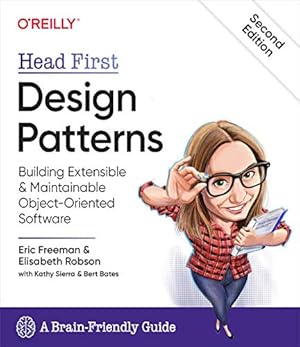
    For that reason, I actually think Head First Design Patterns is overall a better book, but I still recommend buying both. In that book, the focus is much more on the design pattern itself in a general way. That book is much more surface level, but it's also a much clearer and more intuitive introduction to each pattern. Honestly, you should buy both. Start with Head First Design Patterns as a surface level introduction to the design patterns, then use this book as a more in-depth look at each pattern.

    One last minor complaint is the diagrams themselves. The format and symbols used in the diagrams are not intuitive. This is just a problem with the specific visual design language used for the diagrams. It often takes me a couple of minutes minute to figure out "okay these are descendents, and these are member variables, and this contains this other thing, and this calls this." Overall, the style of the diagrams is just not very clear. This contrasts with Head First Design Patterns where the diagrams are intuitive even at a glance.

    Despite all that, this is a really great book. It's well written, it's in depth, it gives a lot of amazing information. These complaints I listed are minor in the grand scheme of things. This is overall a really genuinely amazing book and I'm glad it exists and that I have a copy. Its discussion of each design pattern is just about some of the best in-depth discussion on software design that I've read. I highly recommend buying this book, even if you already have a book on this subject. This is like the formal in-depth professional look at the subject. Also pick up Head First Design Patterns so you understand the design patterns at a surface level first.

    Sending feedback...
    Thank you for your feedback.
    Sending feedback...
    Thanks, we'll investigate in the next few days.
  • 5 out of 5 stars
    Must Read
    Reviewed in the United States on January 26, 2012
    Brief content visible, double tap to read full content.
    Full content visible, double tap to read brief content.

    As others have already noted, this is a seminal work on design patterns and is considered by many software professionals as a must read. It is probably a bit too complex for novices to design patterns in which case they are better off using another resource for starters (e.g.: Head First Design Patterns) and then eventually move on to this book. Head First design patterns was obviously easier to read and understand since the examples are more up to date and material is not as thorough as this book. It took me more than a month and half to read this book carefully from cover to cover. Although a lot of the patterns are discussed in depth from a theoretical level including evaluating trade-offs made with specific implementation choices, the examples in SmallTalk are out of date and not that relevant anymore but that's understandable given the publish date of this book (1994). Like some other books (e.g.: Java Concurrency in Practice), multiple readings are necessary to fully digest the material and that needs to be coupled with either independent practice of the specific implementation choices and/or other resources that have more examples of pattern implementations so as to not only reinforce understanding but also lay a solid foundation for Object Oriented Design. Most senior folks working with Object Oriented Systems typically have this book at their desk as a reference. I found one particular pattern, namely Interpreter, pretty difficult to follow. Other than that the rest of the material is readable. Having some familiarity with UML notation will help but the appendix includes explanation of the notation used in the book, so it is not a stopper if you don't have any exposure in that area. Towards the end of each chapter covering a given pattern, the authors include a section on related patterns which can be extremely helpful. This book also organizes different patterns into creational, structural and behavioral categories and also identifies which ones within a given category can supplement each other and which ones compete against each other. This book is not meant to be a comprehensive resource on design patterns and will have to be supplemented by other books. Highly recommended for anyone working with Object Oriented Systems.

    14 people found this helpful
    Sending feedback...
    Thank you for your feedback.
    Sending feedback...
    Thanks, we'll investigate in the next few days.
  • 5 out of 5 stars
    A reference for every serious developer
    Reviewed in the United States on March 31, 2026
    Brief content visible, double tap to read full content.
    Full content visible, double tap to read brief content.

    Buying this book was a very smart decision. I needed a little of background in object-oriented programming to get the most out of it. The most interesting part is not the catalog, but the principles and the way it explains the object oriented way of thinking. After three decades its content is still relevant. Thank you to the GoF for this seminal work.

    Sending feedback...
    Thank you for your feedback.
    Sending feedback...
    Thanks, we'll investigate in the next few days.
  • 5 out of 5 stars
    Essential well written book for software developers
    Reviewed in the United States on July 6, 2024
    Brief content visible, double tap to read full content.
    Full content visible, double tap to read brief content.

    This is a great, essential book for any software developer who really wants to improve their software designs. When I first read it many years it ago it helped me organize some designs I had "discovered" for myself and introduced me to other designs. It explains not just what the patterns are but WHY you would use each one, how they interact, and when to choose a particular pattern.

    Despite changes in programming style or the "flavor of the month" of programming methodology, the design principles in this book remain valid. Well worth reading.

    3 people found this helpful
    Sending feedback...
    Thank you for your feedback.
    Sending feedback...
    Thanks, we'll investigate in the next few days.
  • 5 out of 5 stars
    Great book
    Reviewed in the United States on September 3, 2025
    Brief content visible, double tap to read full content.
    Full content visible, double tap to read brief content.

    Best book for design patterns there is. Wish it had a soft cover, but oh well.

    Sending feedback...
    Thank you for your feedback.
    Sending feedback...
    Thanks, we'll investigate in the next few days.

Top reviews from other countries

    Translated by Amazon
    See original
  • 5 out of 5 stars
    As a computer programmer you have no excuse not to own this book
    Reviewed in the Netherlands on October 7, 2022
    Brief content visible, double tap to read full content.
    Full content visible, double tap to read brief content.

    Design patterns is the bible that popularized the design patterns movements. While it triggered a lot of offspring books this one is still the most important one by far. It documents 23 design patterns, most of which are still widely used today.

    There is only one caveat for beginning programmers. Time and time again they told me "I don't get it"' after reading the book. You probably need to bump your head a few times against the problems that these patterns solve before you actually see why they are so good. Highly recommended.

    Sending feedback...
    Thanks, we'll investigate in the next few days.
  • 5 out of 5 stars
    iyi
    Reviewed in Turkey on November 11, 2024
    Brief content visible, double tap to read full content.
    Full content visible, double tap to read brief content.
    Sending feedback...
    Thanks, we'll investigate in the next few days.
    Translated from Turkish by Amazon
    See original
  • 5 out of 5 stars
    This is the bible to learn design pattern.
    Reviewed in Japan on May 22, 2021
    Brief content visible, double tap to read full content.
    Full content visible, double tap to read brief content.

    It is really the bible in design patterns.

    If you are considering learning design pattern, I believe you only need this book as the only one book on your way to master it.

    Though the language used in the book including smalltalk (which is dead now), the examples and explanation are really straightforward.

    For readers who are not familiar with design patterns at all, I recommend to first start from chapter three, which has a lot of details in each design pattern. Then come back to chapter one and chapter two, which are summary and comparison for each pattern.

    Sending feedback...
    Thanks, we'll investigate in the next few days.
  • 5 out of 5 stars
    Très éclairant.
    Reviewed in France on September 17, 2013
    Brief content visible, double tap to read full content.
    Full content visible, double tap to read brief content.

    Par ses explications lumineuses et concises, illustrées d'exemples très accessibles, cet ouvrage fait ressentir au lecteur l'intuition de chaque design pattern, et presque imperceptiblement, la transforme en évidence. Écrit dans un style très agréable, comme on en rencontre rarement dans les ouvrages techniques, il se lit comme un roman, tout en présentant une structure très ergonomique, qui permet au lecteur de le parcourir dans l'ordre adapté à ses besoins.

    Ce livre condense tellement d'intelligence du logiciel, et la rend si facilement assimilable, que ça semble miraculeux. La lecture est aisée, et les progrès qui en découlent sont immédiats et significatifs. Le développeur qui a lu ce livre se surprendra à résoudre tout naturellement des problèmes qui lui auraient valu, avant lecture, de longs moments d'errements ou d'hésitation. Un must intemporel pour tout adepte de la programmation orientée objet.

    Sending feedback...
    Thanks, we'll investigate in the next few days.
    Translated from French by Amazon
    See original
  • 5 out of 5 stars
    Satisfeito
    Reviewed in Brazil on July 14, 2025
    Brief content visible, double tap to read full content.
    Full content visible, double tap to read brief content.

    Livro excelente

    Sending feedback...
    Thanks, we'll investigate in the next few days.
    Translated from Portuguese by Amazon
    See original